

Aston Villa are on an astonishing run of form that has catapulted them into the Premier League's top three: They've won 10 of their past 11 league games, and nine in a row across all competitions. During that span they've beaten league leaders Arsenal and second-place Manchester City, plus they've won every single league game off the back of a midweek European fixture, which is notoriously tough to do.
So with Manchester United to come this weekend and Unai Emery's men sitting only three points off top spot, fully five clear of fourth place, people have begun to ask the question: Are Villa genuinely in the 2025-26 title race?
We might not be able to answer that fully until March or April, but here's how they got there.
A terrible summer
The fact that Villa are third in the table is made all the more remarkable by the fact they failed to win any of their first five games this season. Over that period, they lost to Brentford and Crystal Palace, and drew with Newcastle United, Everton and Sunderland, scoring only one goal in the process.
There's no doubt that a poor summer transfer window played a part in the sloppy start. In July, Villa were fined by UEFA for breaching its cost-control rules -- the club spent too much money given the revenue they generated -- and entered into a settlement agreement with European football's governing body. The agreement mandated that the club must end the summer with a positive transfer balance, which led to the club posting a £15 million profit for the window. But not only were top players almost impossible to sign, every single player's future at Villa was uncertain until the window shut.
The £39 million (rising to £43 million) departure of homegrown midfielder Jacob Ramsey to Newcastle United was the key to generating the required revenue, but reports suggested the dressing room was far from happy with how that deal -- and the summer overall -- played out. And England international defender Ezri Konsa went as far as openly saying: "It's really killed us."
There's no doubt this played a huge role in Villa's sluggish start.
Torres' return boosts form
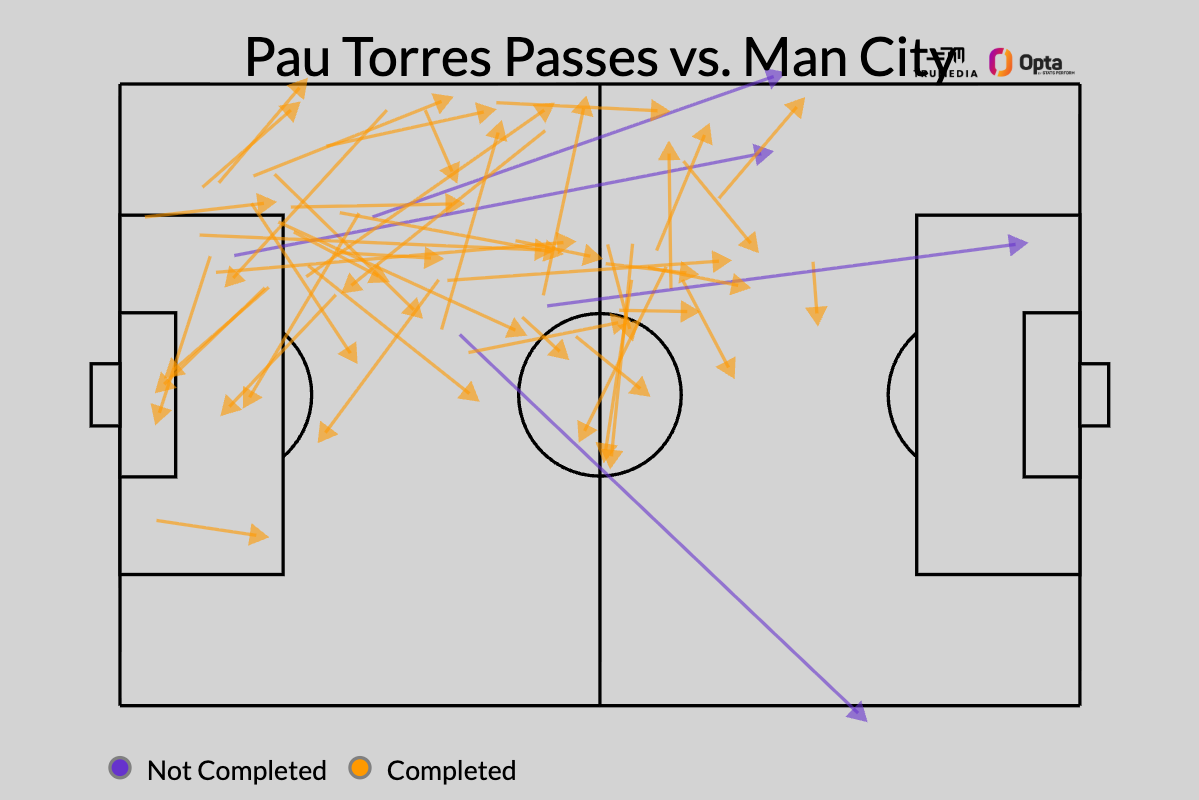
The turnaround began in the UEFA Europa League opener at home to Bologna, where a Villa team low on confidence struggled its way to a 1-0 win in late September. That was followed by a first Premier League victory, 3-1 over Fulham, and from there the club gained steam.
One key change was the reintroduction of Pau Torres, Villa's best passing center back by far, to the defensive line after a spell on the bench. The Spain international is able to move the ball up the pitch more quickly than his teammates, and he's also the best at retaining possession, which is crucial to Emery's controlling style.
So it was a simple case of Torres bringing an element of composure to Villa's possession, giving them enough of a platform to start improving elsewhere.
From there, the form of some key players improved. Attacker Morgan Rogers hit his stride and is now playing the best football of his career -- he has five goals and three assists in his past 11 appearances -- while others perked up too, notably defender Matty Cash and midfielder John McGinn, both of whom have scored important goals, and forward Emi Buendía's impact off the bench has been game-changing at times.
Stats tell a different story
Questions have been raised over whether Villa's run of results is sustainable -- and not only because if they were to beat Man United this weekend, Emery would become the first Villa manager in over a century to record two separate runs of 10 consecutive home wins. It's because the underlying statistics portray the team very differently to the way the official table does.
For example, the Premier League's expected goals differential (xGD) table has Villa in 14th place. That metric takes the club's total xG (16.7) and subtracts their xGA (expected goals against, 21.4), which results in minus-4.7. For context, Arsenal top that table with plus-16.9, while Burnley are bottom at minus-18.0.
Even if you generously remove Villa's terrible first five games from the sample size, Villa's xGD is minus-0.34, which puts them 11th. It's not gaining 30 points from a possible 33 levels of form.
So why the disparity? How have Villa piled up the points at a rate no other team can match for the past two months, sparking mutters of a title charge, but graded out as distinctly average in the data, causing analysts to sound caution?
The answer lies in the type of goals Villa have scored.
Long shooting breaks the model
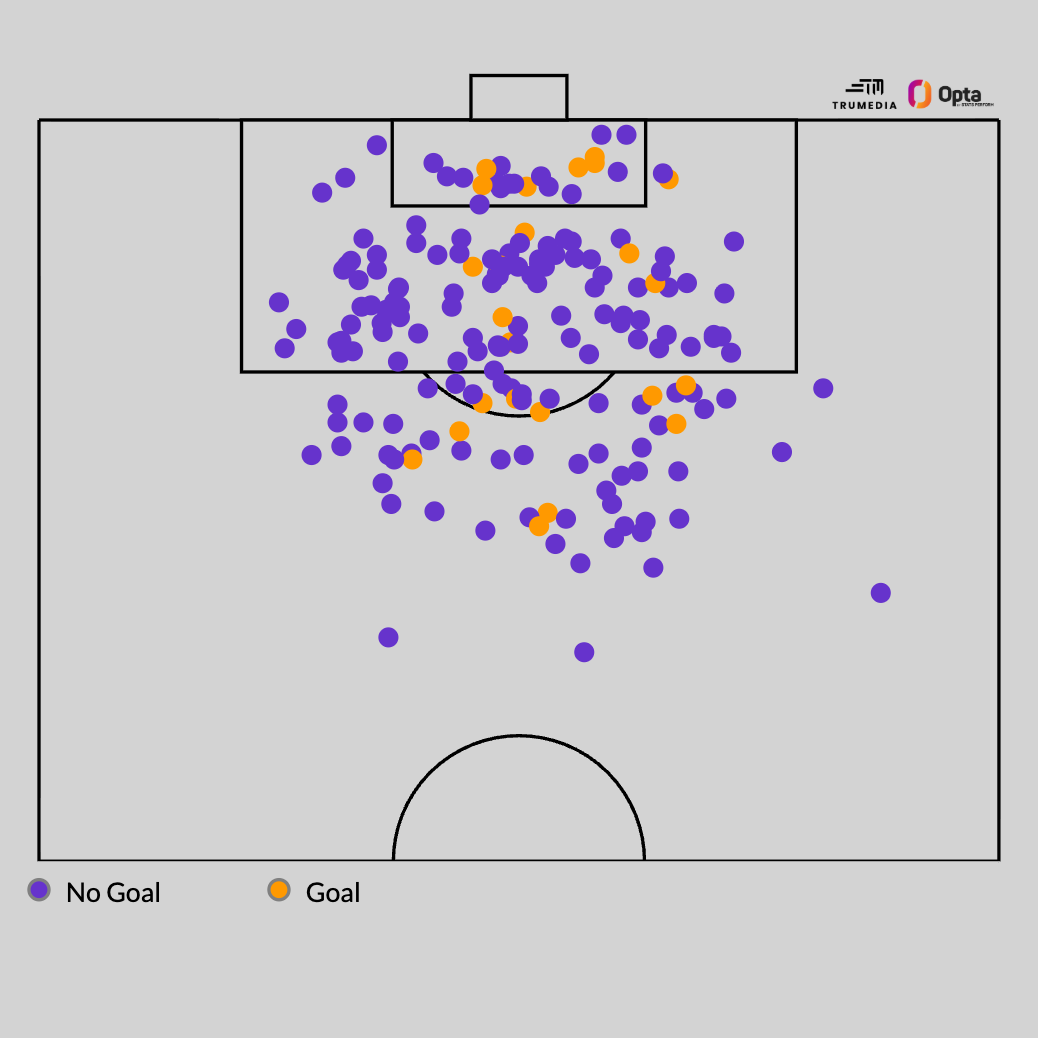
An incredible 10 of Villa's 25 Premier League goals so far have come from outside the box. That's more than any other team in Europe this season, and at least two more than anyone else in the Premier League.
In a run of games spanning roughly 40 days, starting with Tottenham Hotspur away on Oct. 19 and ending with Wolves at home on Nov. 30, seven of their eight goals came from outside the box. This repertoire included two free kicks, a left-footed effort from right back Cash, and a rare goal from defensive midfielder Boubacar Kamara.
When questioned about this after beating Wolves 1-0, Emery framed it as a genuine tactic: "They are practicing a lot every training session and shooting like that. The first 20 minutes they defended so low so we need to shoot and be clinical. We are responding as a team tactically."
It should be noted that this flies in the face of how the modern game has evolved over the past 15 years, as the introduction of xG has laid bare how slim the chances of scoring from range generally are.
For a start, it has led to a massive reduction in long shooting. During the 2011-12 Premier League season, 4,829 shots were taken from outside the box, but by the 2024-25 season, that number had dropped to 3,113 -- a decrease of 35.5%. The average distance from which a shot is taken has also reduced from 17.9 yards to 15.8, via Opta.
Villa firing in goals from range -- including an epic winner from Rogers last weekend against West Ham, rated at just 0.04 xG -- has led to them outperforming their xG total by 8.3, the widest margin in the division.
Good teams and good players overperform their xG, but only to a certain degree. And probably not to this extent.
The Kansas City Chiefs of soccer?
However, xG isn't the only place Aston Villa are running the margins pretty fine. Eight of their 10 wins have been by just a single goal, and only one result -- a 4-0 home win over AFC Bournemouth -- stands out as a dominant scoreline. Compare this to Arsenal, who have won six Premier League games by 2-plus goals (and beat Atlético Madrid 4-0 and Bayern Munich 3-1 in Europe) or Manchester City, who have won eight league games by 2-plus goals (and beat Real Madrid 2-1 at the Bernabéu), and it does paint a picture.
Villa rarely put teams away emphatically and are frequently forced to defend one-goal leads at the end of games. Now credit where it's due: They are clearly excellent at this, and their success in this area is perhaps the key reason they've shot up the table.
Compare and contrast their composure in these scenarios to teams you'd expect to be challenging for the top five, like Newcastle United or Manchester United, and they are worlds apart. The Magpies are conceding so many late goals that manager Eddie Howe has labeled it a psychological issue, while just this month United squandered leads against West Ham and Bournemouth in the 83rd minute or later.
But these two teams serve as cautionary tales. Football is chaotic and random; one-goal leads bring jeopardy. On the balance of probabilities, a team playing out a lot of tight affairs do not win every single one -- and even if they do for a spell, it can turn around very quickly.
To draw an NFL comparison, Villa very much look like the Kansas City Chiefs, who went 11-0 in one-score games in the 2024 regular season. Some of those victories were almost beyond belief, courtesy of blocked field goal attempts and spectacular final plays. They ran the margins very fine.
But the concerning part for Villa is that in the following year, the Chiefs lost their first five one-score games in a row, eventually breaking that streak with an overtime win against the Indianapolis Colts. It just shows that close games will not consistently run in your favor forever.
Will squad depth halt their charge?
Since early November, there has been an obvious uptick in Villa's underlying creative numbers. Their xG in wins against Bournemouth (1.7), Leeds United (1.6) and Brighton (2.3) was more than fine, and the 2.1 xG they accumulated against Arsenal was the most any team has racked up against the Gunners all season -- including Liverpool, Man City and Bayern.
The majority of these games were won by a single goal -- in fact, Arsenal were beaten by the last kick of the game -- but at least Emery's men felt as if they were moving through the gears in attack.
In fact, they've achieved a remarkable amount considering striker Ollie Watkins is having a difficult season with only three goals in 16 league appearances. Though Emery has mentioned that the 29-year-old is dealing with a knee issue, which seems to be affecting his top speed and ability to get shots off.
If Villa could begin to get strong production from their No. 9 -- be it Watkins, backup Donyell Malen, or a clever (and cheap) January transfer window addition -- they could easily go up another gear in the final third.
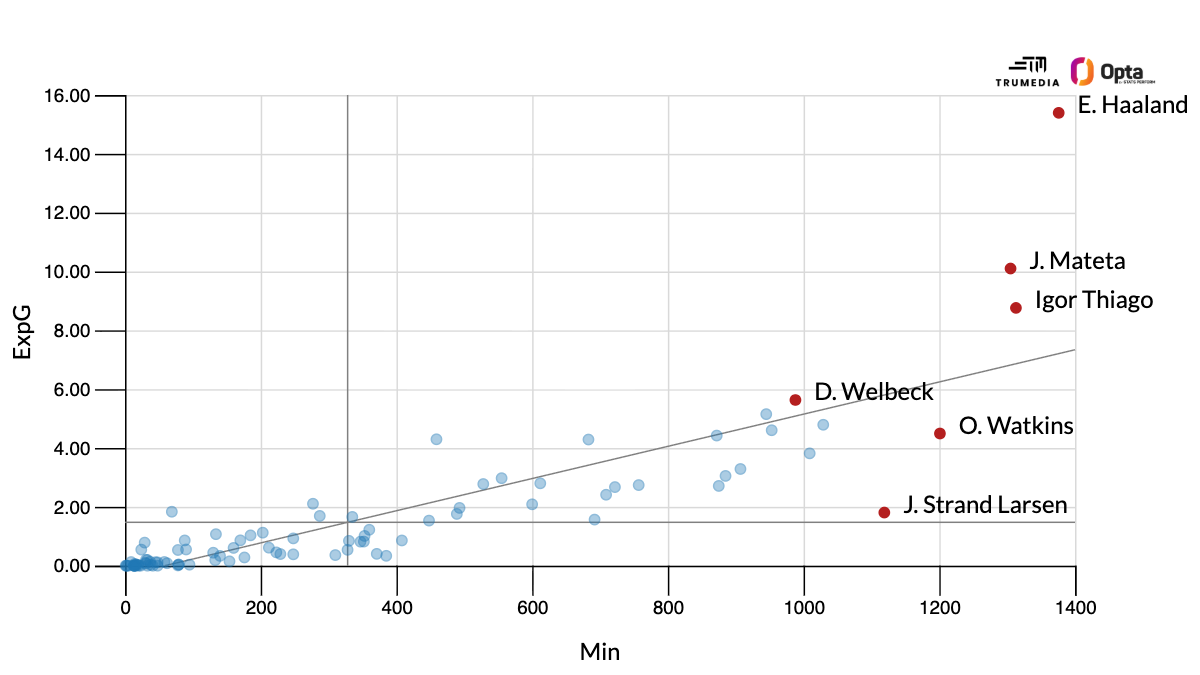
Where Villa really fall short in comparison to title rivals Arsenal and Man City, though, is in squad depth. There's a significant drop-off in quality from Rogers to the next Villa attacker; Konsa and Torres to the next center backs; and Cash to the next right back.
Compare this to Arsenal, who have two class players for every position and have already shown they can cope without star forward Bukayo Saka and midfielder Martin Ødegaard, while they also have an army of elite defenders to call upon; or Man City, whose fully rotated team boasts £40 million-plus players across the park.
Realistically, Villa will struggle to compete with this over the course of a full season -- especially given they have a Europa League campaign to manage too.
Emery's side have rebounded from tough circumstances to put themselves in a phenomenal position, but they are not a dominant team -- in scoreline, in underlying numbers, even in average possession -- nor are they stacked with the options you probably need to reach 80-plus points.
But that's OK. What's crucial for the club is they've put themselves at the head of the pack jostling for Champions League qualification. They're 11 points clear of Newcastle and Tottenham Hotspur, and could go 10 clear of Man United if they beat them this weekend. If title aspirations fall by the wayside, yet UCL football is secured, most Villa fans would be OK with that.