

The long throw-in craze has swept the Premier League again ... just like it did almost 20 years ago. Nearly every team is trying it -- to varying degrees of success -- as fans have become used to the sight of the ball being hurled into the penalty box from afar.
Opta counts a "long" throw-in as anything over 21.9 yards and, as of the 13th matchday, there have been 520 sent into the box this season, with 12 goals (and one own-goal) coming as a direct result. Last season's entire total was 14.
While midfielder Rory Delap, a former javelin athlete in his youth, was a modern pioneer of the long throw -- utilizing its unique capabilities to drive success for Stoke City upon their promotion to the top tier in 2008 -- Brentford are the kings of the long throw now (70 attempts). The Bees scored six goals from these situations last season and have already netted three this term. Meanwhile, Crystal Palace have also bagged three this campaign from 60 attempts.
In total, six different Premier League teams have scored goals from long throw-in situations in the first 13 games, which matches the total number of teams that did so in the entirety of last season. But specialty throw-in coach Thomas Grønnemark -- who has worked with Brentford, Liverpool, Ajax, Borussia Dortmund and more -- insists it should come as no surprise that this trend has taken off.
"All clubs, they're looking at the data and analysis and they're thinking 'Where is our next golden nugget?'" he tells ESPN. "Teams are looking at Brentford and saying, 'wow, they're getting a lot of goals. They're getting a lot of expected goals, a lot of chances, a lot of dominance by long throw-ins.' So they think to themselves: maybe we should try to do that."
Grønnemark is behind football's biggest long throw-in success stories. He coached Danish club FC Midtjylland for five seasons and yielded 46 long-throw goals across that time, while he's worked with Brentford for the last three campaigns, helping them gain a true edge against richer and better teams.
"Football is a low-scoring sport," he argues. "Even one goal, it can win you the game. It can bring you success for the whole season."
So what makes a player great at long throws? According to Grønnemark, it can be broken down into three distinct physical and technical skillsets, but there are also some basics to cover.
- A long throw has to travel at least 37 yards to be considered "world-class," and if a throw doesn't reach the six-yard box then it's almost pointless.
- Teams need more than one world-class thrower to be successful (Palace and Brentford have at least two each).
- Teams also need at least three "good hitters" (headers, duellers, players in the box who can get on the end of it to capitalize.)
The three types
Good long throwers can be hard to find, so how do teams do it? An infamous social media leak over the summer revealed that new Tottenham Hotspur manager Thomas Frank held long throw "auditions" for his squad. The Dane -- who worked closely with Grønnemark while he was manager at Brentford -- has called long throws "a good weapon" that he likes to "have in the toolbox," so will have lined his players up to show what they can do.
Ultimately, Grønnemark believes that the types of player can roughly be sorted into three separate physical categories -- although some special players do cross over into more than one.
Type 1: A tall player, or one with long arms
Discus throwers are often slender athletes, but their longer arms allow them to sling the discus extremely far. And the same applies to football.
"The reason why this type of player can throw far is because the longer arms you have, the further you can take the ball behind your head [the starting point for the throw] and the more power you can put into the throw."
Prime example: Mikkel Qvist starred for Danish club AC Horsens in 2016. He's 6-foot-6 tall and recorded a throw-in distance of 43.2 yards, meaning he was able to cover half the pitch and could reach the penalty spot.
Modern example: Nordi Mukiele's prowess at hurling the ball into the box has helped power newly promoted Sunderland's tremendous start to the Premier League season, and he had the second-most attempts after 13 matchdays (49).
Type 2: A player with a lot of fast-twitch fibers
Some players have more fast-twitch muscle fibers than others, which can produce small amounts of energy very quickly and allow for more explosive, high-intensity actions.
"This player doesn't need to be tall. It can also be a small player."
Prime example: Legendary Brazil and Real Madrid full back Roberto Carlos was famed for his powerful shots and free kicks, but despite at standing 5-foot-6 his throws packed a punch, too. Meanwhile, former Tottenham and Madrid winger Gareth Bale, while 6-foot-1, was also more of a fast-twitch example, and once assisted a goal for Jermain Defoe directly from a launched throw.
Modern example: Bournemouth forward Antoine Semenyo is a unique case when it comes to long throws, as he's one of the few outright attackers in the Premier League that can reach the six-yard box with a throw.
Type 3: A flexible player
At around 1lbs, the ball doesn't weigh much, but it's not about power to throw it into the box it's about technique. And having the flexibility around the hip and shoulder areas helps a lot.
"If you have really flexible shoulder joints, it's a little bit like having really long arms. A lot of the players who I coach to world-class length, who are assisting many long throw-in goals, are not big or strong or tall, they're really flexible in the shoulder joints. I've seen skinny players with good technique throw really far."
Prime example: Stoke's Rory Delap was not overwhelmingly tall or hugely fast, but had immense flexibility and, as a former javelin athlete, could transfer energy into throwing the ball like no other. Hull City goalkeeper Boaz Myhill even once kicked the ball out for a corner instead of a throw-in against Stoke to avoid the Delap threat.
Modern example: Michael Kayode of Brentford is the Premier League's most impressive long thrower at present and has the most attempts (64). Of course he fits into multiple categories here, but his major strength is his flexibility.
The technical elements
Physique is just one part of the equation. Asked for a list of technical elements involved, Grønnemark goes granular, citing 30 parameters, and reels off a series of different things which he looks for when coaching that fit into another three distinct categories.
Firstly, the position a player takes when they arrive on the line. "I'm looking at the distance between the feet, how your hips are positioned, the grip [of the ball], how the ball is positioned behind your head from the start," he says. "I'm also looking at the timing of the release of the upper body, because that can come too early or can come too late."
Second, it's all about the transfer of energy. "It's a little bit like a javelin thrower," he adds. "They're transferring the energy. You can do the same for a football throw-in, and this is also a lot around the hip and the timing and things like that."
And finally, the run-up to the sideline plays a large part in what comes next too. "The faster or smaller players need a little bit more running speed -- not sprinting -- but a little bit more to transfer that energy more efficiently," he says. "I'm also looking here at the different kinds of steps. Are they running with natural steps? Some take two short steps; some have to take long steps; some take really stiff steps, because they're afraid they won't fit their run-up in before the line.
"Some players have jumps in their running. This can be acceptable, if the energy is right, but some players are suddenly in the second-to-last step, jumping up and then coming down again."
Practice makes perfect
Add all of the above together successfully and you might make a good long thrower. But don't stop there. According to Grønnemark, the most naturally gifted player can extend the length of their throws by almost nine yards with practice and conditioning, while even unremarkable throwers can become effective if trained right.
The Danish coach cites Liverpool left back Andy Robertson as a good example of the difference some focused effort can make.
"When I started at Liverpool, Robertson could only throw 21.6 yards, but he improved to 29.5 yards," he says. "Even though that's not world-class [Grønnemark's definition, see above, is 37 yards or more], it added more than 634 square yards to his throw-in.
"He also didn't know when to throw fast, or when to have patience. He learned to read those different spaces.
"The longer you can throw, the greater counter-attacking ability a team can have, because you can't be offside [from a throw]. But also, the longer the throw-in, the greater the throw-in area, which means that you can throw to more teammates."
What are the drawbacks?
Not everyone is good at long throw-ins. Sure, in the wake of Brentford's success last season, every Premier League team is trying it, but not only are very few getting close to their level of threat, they're actually hurting themselves by executing things poorly.
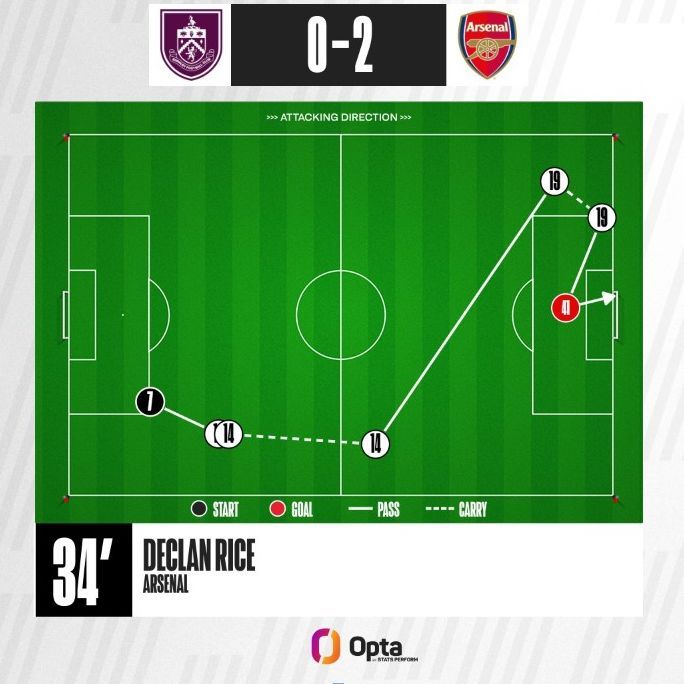
There have been some goals this season scored on the counter off poor long throws. A prime example of this was Arsenal's second goal in the 2-0 win over Burnley at Turf Moor in November: The Clarets lobbed the ball into the box, lost the first contact, didn't have the players in place to recycle the ball, and roughly 15 seconds later, Arsenal midfielder Declan Rice put the ball into the back of their net.
The other major concern is how it dilutes the spectacle.
Long throws can easily take 30-40 seconds each to complete, as the preparation is not simple. The thrower may have to travel from one side of the pitch to the other and will almost certainly take time to dry the ball off with a towel before throwing it; meanwhile the team's center backs have to move up the pitch and into the opposition penalty box to align themselves.
For fans of Brentford, Palace and Sunderland -- teams who have excellent long throwers and setups -- it's often worth the wait. But for fans of many other clubs, the end result is not.
And even Grønnemark shares this concern. "If we see too many low-quality long throw-ins, and have more waiting time, we have less entertainment for the fans," he says. "I feel that many Premier League teams have just seen a video and said 'okay, hurl it in there.'"